Thursday, April 14, 2011

Assisted Suicide: Is It the Government's Business?


This was the headline given to an online Web chat by Nicole Brochu, a columnist with the South Florida Sun-Sentinel. It took place this past Tuesday (April 12, 2011) and featured Derek Humphry (Hemlock Society USA, ERGO) and Greg Swartz (director of Another Harvest Moon, a new indie movie dealing with euthanasia) as panelists. I had been notified by Alex Schadenburg of the Euthanasia Prevention Coalition that this was taking place, and I took the opportunity to participate.

Below is the transcript of the chat. Comments and questions from participants other than the moderator and panelists are in italics; additional information and my own thoughts are noted with square brackets. All bolded emphasis is my own.

==============

1:56 - SunSentinel.com Health: Hi everyone. We will begin our chat momentarily. Please standby.

2:00 - Nicole Brochu [SFSS columnist, moderator]: Welcome, everyone, to today’s chat.

2:00 - Nicole Brochu: I’d like to introduce our panelists.

2:00 - Nicole Brochu: Derek Humphry, considered the father of the right-to-die movement, is the author of “Final Exit,” the groundbreaking how-to manual for terminally ill patients wishing to end their lives.

2:00 - Nicole Brochu: Also joining us is Greg Swartz, the director of the recently released film, “Another Harvest Moon,” starring Ernest Borgnine, Doris Roberts, Anne Meara and Cybill Shepherd and largely centered around one elderly character’s struggle with thoughts of suicide.

2:00 - Nicole Brochu: I am Nicole Brochu, a health columnist for the Sun Sentinel in South Florida, and I’ll be moderating today’s conversation.

2:01 - Nicole Brochu: Welcome, gentlemen.

2:01 - Nicole Brochu: I’ll begin by asking Mr. Humphry: When you wrote “Final Exit” in 1991, it had been 16 years since you helped your wife, Jean, end her suffering from inoperable, terminal cancer. Why did you feel the world needed a how-to on euthanasia?

2:02 - Greg W. Swartz: Hi. Thanks for having me.

2:02 - Derek Humphry: It was only after I wrote a book about Jean's way of death did I realize how much public interest there was, and 5 yrs later founded the Hemlock Societey USA

2:03 - Nicole Brochu: What is the Hemlock Society? What was its mission?

2:04 - Derek Humphry: The Hemlock Society (1980-2003) worked to help terminally ill people with their hastened deaths, if that's what they chose, and, secondly, worked to change the laws on assisted suicide in California and Washington.

[There's some interesting history that bears noting here. The Hemlock Society was founded by Humphry in California in 1980 and moved to Eugene, OR in 1988. Humphry and other Hemlock Society members (under various other names like Oregon Right to Die and End of Life Choices) were major players in the campaign to pass Measure 16, which became the Death With Dignity Act. However, the original draft of the Act would have legalized lethal injection - i.e., not just physician-assisted suicide, but active voluntary euthanasia as well. Since the inclusion of lethal injection was the reason a similar measure failed at the ballot in Washington in 1991, some members of the Measure 16 campaign wanted to take it out. Humphry was incensed and wouldn't let them. The conflict led to Humphry pulling out of the Oregon Right to Die campaign and forming his own organization, ERGO. The Hemlock remnant joined with Compassion in Dying (a Washington-based group) to provide the impetus to win passage of the DWDA in 1994.

I submitted this question through the website chat: "Mr. Humphry, do you support the use of lethal injection for suicides that don't go as planned, as the Dutch do?" The question was screened out by the moderator.]

2:04 - Nicole Brochu: What was the reaction you received in response to "Final Exit"? Was it positive or negative.

2:06 - Derek Humphry: To my surprise, Final Exit leaped into the NY Times bestseller lists and stayed there for 18 weeks. It surprised most people that such a book could be a bestseller. There was negative reaction from the Christian Right, but the intense argument over the book only intensified the sales!

2:06 - [Comment From Chan] - When states enact laws that legalize assisted suicide, are provisions made for adequate safeguards to ensure that the individual has not been hastened to his or her decision by unscrupulous relatives who might have an ulterior motive, say, a potential inheritance?

2:08 - Derek Humphry: The existing Oregon and Washington laws permitting physician-assisted suicide for its terminal residents have a clause in the law making it a crime to pressure or influence a person to hasten death. [I sent in a comment on the chat noting that in Oregon, this supposed safeguard has been gotten around by determined families in documented cases, mentioning Kate Cheney by name and providing a citation. The comment was screened out.]

2:08 - Nicole Brochu: Greg, what inspired you to take on a film whose central character grapples with thought of killing himself?

2:08 - Greg W. Swartz: The film (which was a play first) appealed to me on a practical level because I wanted to make a drama that was small in scale but universal in subject matter. Then, I went through a very difficult time involving my own father's death. And that really made it personal for me.

2:09 - Nicole Brochu: How has the film been received by audiences as you take it from city to city?

2:10 - Greg W. Swartz: We have taken the film to many films festivals... from Hollywood to Indianapolis to Providence, RI, and the one thing that happens at every single screening is the line of people that forms afterward.

2:10 - Greg W. Swartz: They line up to tell me and the producers stories of their own that are similar to the one in the story... personal tales of people facing their own end-of-life dilemmas.

2:11 - [Comment From Dennis] - Where should the line be drawn if, indeed, assisted suicide should ever prevail? Could I decide if I were blinded that I simply wanted to exit life? If I were paralyzed, should I be able to choose assisted suicide or would it be strictly TERMINAL candidates only?

2:12 - Nicole Brochu: Shouldn't you be allowed to decide when and how you die no matter what you are suffering from, Dennis? [Ah - that’s the attitude Humphry, Kevorkian, and the others want.]

2:12- Nicole Brochu: I mean, who else should decide that? The government?

2:13- Nicole Brochu: In fact, suicide is perfectly legal in America. It's getting your doctor to help with painless, peaceful options that is banned in most places.

2:13- Greg W. Swartz: We chose not to take sides with the film, but rather to show the various characters representing various viewpoints. I have my own POV on the issue, but it's not necessarily in the film.

2:13 - Nicole Brochu: What's that point of view, Greg?

2:14 - [Comment From Dennis] - The govt won't have an opportunity to influence my decision to die in any case, legislated or not!!

2:14 - Derek Humphry: Physician-assisted suicide (PAS) should only be for a competent adult who is terminally ill and near the end. Two doctors should attest to this. I don't believe P A S should be available for persons with mental health issues, or clinical depression. Also, the present OR and WA laws forbid assistance on the grounds of old age or handicap. [What?!? That’s not true. It’s all about a handicap (a physically debilitating condition) determining whether your suicide is “rational” or not.] That's wise.

2:15 - Greg W. Swartz: As I said, I watched my father die an agonizing death. It happened in a matter of weeks, so it never quite came down to assisted suicide, but it's certainly something we discussed (about him and with him). I think it's a personal choice and, had he chosen that, I would have helped him. Or supported him in doing so himself. [And this POV is not in the movie? Really?]

2:16 - [Comment From George] - Can you ,in a simple explanation ,Mr.Humphry,state how a person can commit suicide?I have your book( 2002 ),but rather complex solution!

2:17 - [Comment From Bunny] - Terminally ill patients can choose hospice.

2:18 - Derek Humphry: It is not easy to bring one's life to an end, except violently, which is terrible. The various ways of peaceful, justifiable hastened death are outlined in the book 'Final Exit'. It requires courage, planning and -- hopefully -- family support.

2:18 - [Comment From Lionel from Belgium] - Here in my small country euthanasia has been legalised for almost 10 years now and was performed on thousands of people (official statistics). 80% of them did not consent. do you really believe that you are going to be able to prevent that in the US? Many non-terminal people are being pressurized today, I personally know dozens of cases.

2:20 - Derek Humphry: As to Belgium, assisted suicide is only by doctors, according to a specific law. I don't believe that 80percent did not consent. That would be outrageous and cause an uproar in a country which is proud of its rule of law. [Oh, that’s nice – just deny it, implying that Belgium would be in chaos if it were true. Maybe they’ve been successful in Belgium where you haven’t yet been in America, Mr. Humphry – they’ve changed attitudes such that society doesn’t care anymore about sick, elderly, or disabled people who suicide.]

2:22 - [Comment From Dom] - I tried to volunteer at my local Compassion and Choices, but my offer was turned down. It bothers me that the focus of many right to die groups are just the old and the sick. I don't understand why this isn't being stressed as a human right for all people of all ages. [There it is again – “proper”, “sensible” thinking according to PAS advocates.]

2:22 - Nicole Brochu: Greg, how do feel a film of this nature would have been received 20 years ago, when polls on the public’s acceptance of the idea of assisted suicide were much lower? Would any Hollywood producer have dared to touch the subject?

2:23 - Greg W. Swartz: i think that the conversation has certainly changed. Dr. Kevorkian really brought it to the national table and that has really shifted public opinion... or at least opened up a dialogue. I think that 20 years ago, it would have been more controversial for sure. I'm just not sure that the film would have been made... at least in a serious way. It would likely have been some sort of melodrama back then.

2:23 - [Comment From Linda] Mr Humphry, How profitable $$ is your assisted death business?

2:28 - Nicole Brochu: Stand by. Mr. Humphry is preparing his answer now...

2:29 - Derek Humphry: My organization, ERGO, is a nonprofit group incorporated in Oregon since l993. It makes a tiny profit. As to my receiving royalties from the 15 books I've written, they put food on my table. I've been a full time writer for 60 years.

2:29 - [Comment From Kathleen] [Well, what do you know? They took one of mine!]

I have a family member who suffers from paranoid schizophrenia – I mean, really suffers. I know you said that assisted suicide should not be available for people with mental illness - but what about a past history of mental illness? A dual diagnosis of mental illness and some other chronic (painful, but not terminal) disease? Is there a difference in your mind between the suffering that would allow a terminally ill person to end their life and the suffering endured by the chronically mentally ill? What if the mentally ill person is suffering more than the terminally ill person? Haven’t the Dutch and the Swiss allowed mentally distressed people to die?

2:32 - [Comment From Diane] - Why is it that we can help our pets die peacefully,but not our loved ones or ourselves? Doesn"t make sense.

2:32 - Derek Humphry: I am not an expert in mental health issues. I leave that to persons more experienced. Yes, the Dutch and Swiss laws do permit assisted suicide for long-term, seriously ill mental patients who have not responded to treatment. But very few are actually helped [nice word choice!] because it is so difficult to assess the nature of the suffering. [Really? There are ‘natures’ or ‘degrees’ of suffering? I thought you thought suffering was simply evil in all its forms…] This is a real problem. [Ah, thanks for that. The problem is that too few mentally ill people are encouraged to die. I get it now.]

2:32 - Nicole Brochu: I like that point, Diane. I ask that all the time.

2:33 - [Comment From Lionel from Belgium] - The Belgian law allows mentally depressed people to have euthanasia after one month. A few years ago a 16 year old having attempted suicide was brought to an emergency room. The doctor did not want to resuscitate her because, he said, she had wanted to die. [This is horrifying. Do the panelists or the moderator follow up on it? No.]

2:34 - Greg W. Swartz: I am a filmmaker, not an expert on any of these issues, but i did my homework in preparation for this film and I really came to feel that every single case is unique and needs to be dealt with as such. I personally feel that we can build a system that, while not fool-proof, can certainly have a lot of protections built in to it. [That’s what the Oregonians and the Belgians thought they were creating – and that’s why we keep pointing out the gaping holes in the “safeguards”.]

2:34 - [Comment From Tom] - This is really sad that people are so unintelligent to think that it's okay to make someone else suffer through living when they simply don't want to. This is so sad and outrageous and please how do we change it?

2:35 - [Comment From Bill] - I saw Harvest Moon Saturday in Boca Raton with an all senior crowd. Over half of them, about 25 walked out when they saw the gun in the movie. They couldn't deal with the subject matter, even though I feel you had toned it down quite a bit so as not to offend anybody. Anyways, thank you, I enjoyed the movie.

2:35 - Derek Humphry: As to pets suffering, the tough answer is that there are very few laws regarding pet euthanasia -- as long as it is done painlessly and justifiably. Whereas we humans have erected a huge amount of laws -- and taboos [Ha! Knew he’d use that word!] -- protecting human life.

2:36 - Greg W. Swartz: Thanks. I'm glad that you enjoyed the movie. I have seen the film with more crowds than I can count and I haven't seen anyone walk out, but I do know that it's pretty intense subject matter (and the films certainly doesn't hide from that). It's not always an "easy" film to watch, but the performances are, in my opinion, very strong and I hope that most people find it a worthwhile experience.

2:36 - [Comment From Sherman] - What can people do to advance the legalization of suicide?

2:37 - Nicole Brochu: Greg, did you feel like you were taking a risk with the subject matter, given that assisted suicide, and suicide in general, is still a controversial topic?

2:38 - Greg W. Swartz: Yes. we knew it was a risk. That was part of the appeal to the artist in me. But we approached some truly legendary actors and they responded so strongly that we knew that there was an audience (because those actors are not only great, they ARE the audience).

2:40 - Derek Humphry: Sherman: Suicide is NOT a crime, anywhere. It used to be in Europe. It's the careful advancement of physician-assisted suicide for the dying which I am fighting for. [Pants! On! Fire! You advocated for lethal injection. You think the chronically mentally ill should be allowed to suicide. You admit to an economic/cost-saving argument in favor of legalizing PAS. “Careful”, my arse!] Assisted suicide is state, not Federal law, so the law should be reformed either by legislators or by citizen vote, such as we have done in Oregon and Washington states.

2:41 - [Comment From Bob] - Isn't it difficult to have each state reaching a different decision on assisted suicide? Is there any movement for some sort of federal law to make it legal?

2:42 - [Comment From Guest] - I read that assisted suicide is also legal in Montana. Is this so?

2:42 - Derek Humphry: Bob: Assisted suicide is STATE law. Nothing to do with Federal law. I think we'd have to change the Constitution to alter this!! [ “’…Man is endowed by his Creator with certain inalienable rights, among them the right to death’… uh… hey, Tom, what should we put next?”]

2:43 - Nicole Brochu: Yes, Guest, Montana became the third state to legalize physician-assisted suicide at the end of 2009 -- by a state Supreme Court decision. [Not quite – the court said there’s no constitutional right to it, but there’s no law against it as of yet.]

2:44 - [Comment From Rene Barrett] - Are there lobbiest & others in the medical arena opposed to assisted suicide because of the trememdous revenue generated by end of life care?

2:45 - [Comment From Eunice] - How about Florida?

2:45 - Nicole Brochu: No, Eunice. Assisted suicide is not legal in Florida.

2:46 - [Comment From Anne] - What is behind the fear in resisting this idea? My sense is that many people shut off the notion, refuse to think about or discuss it. Is religion the main culprit? What is the root of the fear, do you think?

2:46 - Derek Humphry: Rene: Yes, There are divergent views on assisted suicide, but mostly those opposing do so on ethical and/or religious grounds. I have heard that some groups -- on both sides -- employ lobbyists.

2:48 - Greg W. Swartz: One of the characters in the film (Ella, as played by Anne Meara) has a very intense scene where she is praying about the fate of her friend, Frank (Ernest Borgnine). It was an interesting part of the film for me because Anne and I both felt like the character was not religious, so she's not very "good" at praying. It is yet another impossible-to-answer part of this that is definitely very personal.

2:49 - [Comment From Jack] - What are the plans for releasing this movie on dvd or blu-ray?

2:50 - [Comment From Rene Barrett] - Of course they have to use "ethical and/or religious grounds". They can't admit to wanting to make money from a drawn out anguished death. [Would you rather the government or insurers make (e.g. save) money from ill people suiciding?]

2:51 - Greg W. Swartz: The movie is going to be released on DVD and on Blu-Ray, but we don't yet have dates because it's still showing in theaters (and we're hoping that it continues to show to wider and wider audiences. It has been showing in Florida for two weeks now. If you belong to Netflix, you can put it in your queue, but it doesn't have a date. It will also be on iTunes and the trailer is showing there already.

2:52 - [Comment From Guest] - Isn't part of the problem, too, because of life insurance? That insurers don't want to make payments in cases where people have ended their own lives?

2:55 - Derek Humphry: Life insurance is really not an issue here. The law throughout the USA is that if a person commits suicide (for whatever reasons) and the policy is two years old, then the money must be paid. (One year in Colorado.) So check the date on insurance policies.

2:55 - [Comment From Gary Stein] - Did the Kevorkian movie, You Don't Know Jack, help bring a greater understanding of assisted suicide? Do you think it helped change attitudes?

2:56 - Greg W. Swartz: I don't know that my film or the Kevorkian will directly change minds, but they get people thinking and they can, if we're lucky, help people make up their minds. I'm not a moralistic artist, so I'm just trying to get people talking.... thinking... whatever it takes. [Sure you are. Everyone’s got a moral point of view. And yours will be reflected in your movie. Guaranteed.]

2:58 - [Comment From Fred] - There's no excuse not to be informed. Greg, will you please make a documentary about inmendham so that people can figure out that suffering is additive?

2:58 - Greg W. Swartz: I'm not really a documentarian and I'm not familiar with him, but I'll certainly look into it. Today.

2:58 - Derek Humphry: Gary: I credit Dr Kevorkian with bringing huge attention to the whole euthanasia issue. Last year's film and documentary were very impressive. My reservation with Kevorkian is that he has left nothing behind for other dying people to take advantage of -- no legal reform, no medical advancement. [Really? Is that all? No concern about his desire to vivisect people as they die? No concern that he killed people without terminal or even chronic diseases? No other reservations? Really?]

2:59 - [Comment From Eunice] - Thank you for addressing this problem.

2:59 - Greg W. Swartz: thank you.

2:59 - [Comment From Noreen] - Thanks for this chat. I can see that there are no clear solutions and each candidate must do her/his own search of what is possible....before it's too late. Thanks for raising the issue and inviting people to consider end-of-life issues.

2:59 - [Comment From Fred] - thank you.

2:59 - Derek Humphry: It was a good debate. [Debate? Not so much. There were some comments and questions sent in that would have made it something less than the lovefest this was, but they were screened out by your sympathetic moderator – see her comment at 2:12.] Thanks. Derek H

3:00 - Nicole Brochu: Thank you all for participating in today's discussion. It's a very complex issue. Any final thoughts from our panelists?

3:00 - Derek Humphry: Perhaps pay a visit to my web site www.finalexit.org

3:00 - Greg W. Swartz: please feel free to keep asking questions about this at our film's site or on our facebook page. I hope that you'll check out the film. It's been a pleasure.

3:00 - SunSentinel.com Health: Thanks to our panelists for joining us today and participating is this discussion. And thanks to everyone who sent questions and linked to our health chat today.

3:01 - SunSentinel.com Health: Check out Nicole Brochu’s column from April 11, "Assisted suicide: Uncle Sam should just butt out."

3:01 - SunSentinel.com Health: Finally, a transcript of this chat will be available shortly at www.SunSentinel.com/transcript

==============

This was a very interesting experience. Felt like a good workout... I have the feeling I'll have to keep myself "in shape". I don't think this issue is going away anytime soon.

Wednesday, March 23, 2011

On The Reasonability of Faith

Yesterday I found myself surfing blogs and landed at one of my favorites, Secondhand Smoke. The author (Wesley J. Smith) writes on life issues, bioethics, and human exceptionalism, and as a member of the International Task Force on Euthanasia and Assisted Suicide, he occasionally takes up the issue.

I noticed this post having to do with Oregon's DWDA and commented on it; visit the thread to see the conversation. Another commenter asked me a question, and it sparked a couple of pages in response. ("Poke the amateur philosopher/theologian with a stick, and see if she moves!") I decided to post the full text here for any interested readers.

The question:

@Kathleen Lundquist,

What you seem to be saying is that something that’s not in the scientific literature can’t exist — which seems to be placing an awful lot of trust in “soft” sciences like psychology and psychiatry. Do you believe that if enough people label a thought irrational then that’s conclusive evidence of irrationality; that rationality is something that requires a majority vote? Just asking.

HW

My response:

To clarify: I don’t regard psychiatric/psychological theory as supremely authoritative in all situations; I’m not a psychologist or Jung devotee or something like that. My familiarity with the field and its guiding principles comes from: 1) several stints throughout my life of working in my parents’ office (Dad practiced clinical psychiatry for 35 years, Mom was a psychiatric/mental health nurse practitioner) and my relationships with them; 2) my 15-year career as a medical transcriptionist in other contexts, including reading and editing thousands of psychiatric medical records; and 3) my relationship with my older brother, who was diagnosed at age 14 with paranoid schizophrenia (he’s now 51) and our family’s experience as consumers of mental health care. As I mentioned before, I’m just trying to find and express logical arguments against PAS that might carry weight with some readers, and since most folks agree that any wish to die has at least some psychological component, I’m trying to cite facts that are relevant to the discussion – and at least let people know that, contra Mr. Eighmey, there’s no consensus in psychiatry that PAS is now a neutral or acceptable act.

Here’s a G.K. Chesterton quote that perfectly illustrates my point of view on rationality; I hope you and Wesley won’t mind if I post the whole long thing:

Every one who has had the misfortune to talk with people in the heart or on the edge of mental disorder, knows that their most sinister quality is a horrible clarity of detail; a connecting of one thing with another in a map more elaborate than a maze. If you argue with a madman, it is extremely probable that you will get the worst of it; for in many ways his mind moves all the quicker for not being delayed by the things that go with good judgment. He is not hampered by a sense of humour or by charity, or by the dumb certainties of experience. He is the more logical for losing certain sane affections. Indeed, the common phrase for insanity is in this respect a misleading one. The madman is not the man who has lost his reason. The madman is the man who has lost everything except his reason.

The madman’s explanation of a thing is always complete, and often in a purely rational sense satisfactory. Or, to speak more strictly, the insane explanation, if not conclusive, is at least unanswerable; this may be observed specially in the two or three commonest kinds of madness. If a man says (for instance) that men have a conspiracy against him, you cannot dispute it except by saying that all the men deny that they are conspirators; which is exactly what conspirators would do. His explanation covers the facts as much as yours. Or if a man says that he is the rightful King of England, it is no complete answer to say that the existing authorities call him mad; for if he were King of England that might be the wisest thing for the existing authorities to do. Or if a man says that he is Jesus Christ, it is no answer to tell him that the world denies his divinity; for the world denied Christ’s.

Nevertheless he is wrong. But if we attempt to trace his error in exact terms, we shall not find it quite so easy as we had supposed. Perhaps the nearest we can get to expressing it is to say this: that his mind moves in a perfect but narrow circle. A small circle is quite as infinite as a large circle; but, though it is quite as infinite, it is not so large. In the same way the insane explanation is quite as complete as the sane one, but it is not so large. A bullet is quite as round as the world, but it is not the world. There is such a thing as a narrow universality; there is such a thing as a small and cramped eternity; you may see it in many modern religions. Now, speaking quite externally and empirically, we may say that the strongest and most unmistakable mark of madness is this combination between a logical completeness and a spiritual contraction. The lunatic’s theory explains a large number of things, but it does not explain them in a large way. [from Chesterton’s Orthodoxy]

As you might guess from this, I make a distinction between the concepts of “rationality” and “healthy, integrated human consciousness”. Rationality (i.e. facility with logic) is a component of a healthy mind; some are born adept at it, most others can be taught to reason ‘if A=B and B=C, then A=C’ and construct an argument, etc. But it’s not everything; a person can be impeccably logical and quite insane. To put GKC’s point another way, the madman isn’t the one who’s lost his reason; the madman is the one who has lost his perspective, i.e. his ability to perceive and process information that threatens to reconfigure his tightly closed mental circle.

There might be said to be concentric circles of rationality, wider and wider webs of theory and belief systems that explain more and more of the humanly perceptible phenomena in our universe (including experiences that seem to go beyond the five senses). My own construct would place the, as you say, soft science of psychiatry/psychology with its rational, codified methods of observation and study within the wider circle of American medical practice as I’ve experienced it (which contradicts some of those theories), placing that within the general knowledge of history and culture I’ve absorbed as an American citizen, placing that within my Judeo-Christian worldview, which is the lens through which I observe, interpret, and integrate as much of my knowledge and experience as I can to perceive meaning and purpose in my life. In the types of discussions we have here at ShS, I do my best to locate common assumptions or axioms from whatever circle I can find, and construct a logical edifice from there. Whether my efforts change any minds is another question entirely.

I have this to say (again, best expressed by Chesterton) regarding faith, evidence, and dogma that may help you understand how I and many other religious people perceive the relationship between faith and reason:

Upon this point there is a simple logical fact that only requires to be stated and cleared up. Somehow or other an extraordinary idea has arisen that the disbelievers in miracles consider them coldly and fairly, while believers in miracles accept them only in connection with some dogma. The fact is quite the other way. The believers in miracles accept them (rightly or wrongly) because they have evidence for them. The disbelievers in miracles deny them (rightly or wrongly) because they have a doctrine against them. The open, obvious, democratic thing is to believe an old apple-woman when she bears testimony to a miracle, just as you believe an old apple-woman when she bears testimony to a murder. The plain, popular course is to trust the peasant’s word about the ghost exactly as far as you trust the peasant’s word about the landlord. Being a peasant he will probably have a great deal of healthy agnosticism about both. Still you could fill the British Museum with evidence uttered by the peasant, and given in favour of the ghost.

If it comes to human testimony, there is a choking cataract of human testimony in favour of the supernatural. If you reject it, you can only mean one of two things. You reject the peasant’s story about the ghost either because the man is a peasant or because the story is a ghost story. That is, you either deny the main principle of democracy, or you affirm the main principle of materialism—the abstract impossibility of miracle. You have a perfect right to do so; but in that case you are the dogmatist. It is we Christians who accept all actual evidence—it is you rationalists who refuse actual evidence, being constrained to do so by your creed. [GKC, Orthodoxy]

For another picture of the relationship between faith and reason, feel free to peruse an essay I wrote several years ago for Catholic Exchange: http://catholicexchange.com/2008/06/03/112743/

This is probably much more than you expected, but as I said, I found your question interesting. Thanks for reading.

KJL

Friday, July 17, 2009

Further clarity on CL Vacation 2009


After a few more days of mulling over my experience at Vacation this year, and after talking with my friend Tami, I've moved further ahead in my understanding of what happened to me there.  I want to offer just a bit more clarity for anyone concerned about my sense of "what I deserve" from God (as I mentioned below), or from my friends in particular or Communion & Liberation in general.

I wish to be clear that this moment of seeing my heart as "black" and perceiving a chasm between myself and what I desired was not a psychological 'low self-esteem' thing, nor were my fears due to any perceived slights or rejection on the part of anyone at the Vacation.  I knew that, on the basis of my experience of the several days before, anything I chose to share would be given room and appreciated by the group.  In the same moment that I felt this deep unworthiness, I did not doubt that I was loved.  This produced a new thought; it challenged me to entertain the possibility that I could be accepted and loved even more deeply, beyond what I thought I could earn by being entertaining or being nice to people.

I believe that this opening up of my heart to a new sort of hope allowed me to see further into the great depths of my need for the Infinite Mystery – to really feel its force in my soul.  If I had sung my song during the assembly reflection time and brought the house down, brought grown men to tears, even had everyone on the carpet prostrate and worshipping me – this would not have satisfied my desire.  What I saw so starkly in that moment was that the answer to the needs of my heart was beyond my grasp – beyond any human grasp.  The source of the beauty, love, and grace that I saw in the people around me wasn’t in them; as they spoke, their hearts became windows into the Beyond, where all those good things live in their fullness.  The only way I could possibly come to possess that goodness and love in its fullness was to beg God to give it to me, somehow.  He would have to give; I could only receive.

Because we are finite beings, I think we often engage in a mental reduction of our relationship with God to the sort of social reciprocity we expect with one another.  When we go to Mass, and Christ miraculously shows up in the appearances of bread and wine – he doesn’t have to do that every time.  He chooses to do that, every time, for us.  He doesn’t owe it to us – not for any moral or theological reason.  He gives Himself in response to our prayer, asking for Him.  His love for us is active and intentional – never grudging, never assumed – always simply a gift.

(H/T: Photo by Joe Soprani)

Sunday, July 12, 2009

A reflection on CL Vacation, 2009


I had an extraordinary time on Vacation with the Northwest CL groups in Bellingham, WA over the Fourth of July weekend. 

Some background on me:  I’m a convert to Catholicism from evangelicalism.  I lived and worked in the Christian contemporary music subculture (both in church settings and in Christian retail) for several decades and was approaching a nadir of total despair at the propagandist nature of it when I discovered the Catholic Church’s artistic tradition and their strong theology of art, and I followed my attraction to the Mystery (which Beauty conveyed to me) into the Church in 1999.  Due to my upbringing, I have a strong sense of the secular nature of my vocation as an artist and, to be perfectly frank, “church music” is now a cross that I reluctantly carry when I’m forced to do so by peer pressure or a sense of duty.  So, when my friends told me that I would not need to sign up to help with anything (registration, ushering, music, etc.) since it was my first time at a CL Vacation, I was grateful – happy at the prospect that they would allow me just to go and participate in the activities.

Alas, it was not to be.  Shortly after we arrived at The Firs in Bellingham on Wednesday evening, before I even checked into my room, my friend Rose (from the Portland SoC) asked if I would be willing to help with music for the weekend.  I remember mumbling something ambivalent and noncommittal, and she told me to look for one Richard From Singapore, who was in charge of the music.  She then sped off to tend to her four younger siblings (their mom Catherine was due to arrive Thursday night).

I paused and asked myself what I should do – whether I should take my guitar out of the car and find this Richard From Singapore and find out what was going on, or just leave it in the trunk and pretend I knew nothing about leading groups in singing – keep my head down and voice low, and not do anything which might cause someone to expect something from me.

I looked around the parking lot and saw several of my friends from Portland, with whom I’d had significant and grace-filled conversations over the past three years in SoC.  In that moment, I noticed that the resentment I’d expected to feel at the mere mention of helping with music was… absent.

So, I went to the building where we were to gather that evening and found the tall, handsome Caucasian man whom the other responsibles identified as Richard From Singapore.  Rose had already told him that I might be coming, and when I walked in, he said, “Ah, you must be Kathleen!  Are you here to help with the music?”  I looked at him, trying to take him in, and paused again before answering.  I looked down at the guitar case in my right hand and said, half-surprised, “Well, Rose told me you needed help, and since I’m here, and I’ve brought my guitar, I – I guess I’m here to help you.”

From that moment on and throughout the weekend, my expectations and assumptions were exploded one right after another.  Richard was very well versed in CL’s repertoire and very organized, which made it easy for Joe Amsberry (from the Salem SoC) and I to help Richard choose and rehearse enough songs for the gatherings each day as well as for daily Mass.  Our planning/rehearsal times were chinked into the cracks between meals and assemblies and reflections, and though we were responsible for a lot, it never felt burdensome – I never felt like I was missing something going on somewhere else while we were rehearsing.  Richard is also an extremely talented singer with highly-polished performance skills, and working with him was wonderful fun for me for the following strange reason:  He was so high-energy, so crazy, and so good at what he was doing that I felt free to be as high-energy, crazy, and good as I could be.  The vibrant energy with which Richard strove to live out his bright, shiny Richardness enabled me to find the place in myself where I can be bright and shiny, in the moment, no matter who’s listening or what purpose it may serve.  In the midst of the fortuitous mix of sacred and secular music we played and sang together over that series of days, I sensed friendly spaces where my own Kathleenness could come out and play.

At the same time something else was happening in my soul at a deeper level.  While doing music with Richard and Joe was a joy, it also seemed to touch a deep wound in my heart – something I couldn’t quite articulate.  At times, I remembered that I had brought my guitar on the Vacation in order to sing some of my original songs for my friends, and I kept trying to figure out a time and place when it would be appropriate to do so.  I thought at first that Saturday’s Talent Show would be the proper venue, but most of the other performers’ acts were light-hearted and comedic – and my songs tend to have a darker melancholic tinge to them.  I decided to stay on the light side with my offerings, but my original goal of singing my own songs for everyone started to flare up and singe the edges of my thinking – it began to distract me from what was happening in front of and around me. 

By Sunday morning, the last day, we were beginning to consider and make judgments about everything we’d experienced together.  We began to sense the weight and significance of the revelation of truth, beauty, and goodness of Christ we had experienced in our friendships with one another.  As various people went to the microphone and shared reflections and questions at our last assembly, the seriousness of our conversation made me think that this might be the time for me to share one of my own songs.  However, as I listened to my friends tell their stories and insights, the Holy Spirit led me in a different direction. 

Tami (from the Portland SoC) was one of the first to speak, and she related how she was struck by the presence of Bishop Joseph Tyson (of the Archdiocese of Western Washington, who was with us on Friday and said Mass for us that evening).  She talked about our use of the word ‘witness’ in CL – that is, we speak as witnesses to our experience with Christ, but she added another meaning to the word – that of being witnessed, of being seen.  She was impressed not so much by the fact that we had the opportunity to see and meet the bishop, but that he had seen and met us.  We were witnessed, we were seen by him.

I continued to listen as Catherine, Steve, Keith, and others shared their experiences, but this insight from Tami began to soak through my distracted mind, steeping in the waves of my thoughts like leaves of a strong black tea. 

I rehearsed in my mind the words of the song I intended to sing and, though I had consciously written it with some CL vocabulary in mind, I realized that the people in this room, much more than anyone at the coffeehouses I frequented, would understand exactly what I was saying.  In singing this song, I would quite possibly be revealed for who I really am.  I might actually - be seen.

And suddenly I was filled with terror, and sadness, and – shame, I think.  The thought of doing the song, the thing I’d so wanted to do all weekend that had put such a torque on my attention, now made me recoil in fear.  I began to cry and couldn’t stop, not even during the Mass that followed the assembly.  My heart seemed so black and ugly, and I felt so ashamed of myself – for wanting more of these beautiful people than I deserved.

Over the past week since arriving home from Vacation, I’ve been trying to process my experience and make some sort of judgment about it.  I found it difficult at first to find words and images to frame my thoughts, but these words, by my favorite songwriter Sam Phillips, have been a help:

I, I love you

when you don’t – when you don’t do anything

When you’re useless, I love you more

When you don’t do anything


When you don’t know, when you don’t try

When you don’t say anything

When you don’t move, when you don’t win

When you don’t make anything work 

 - Sam Phillips, Don’t Do Anything, Nonesuch © 2008

The judgment that's formed so far in my mind is this:  I believe that God granted me a glimpse into the great depths of my heart’s need for Him and the reality of His love for me.  I really felt the force of my heart’s attraction to the Infinite Holiness, the Perfect Love and Beauty toward which all earthly loves point. 

The quote below also reminds me of the source of my truest desire, my real destiny:

"It is Jesus that you seek when you dream of happiness; he is waiting for you when nothing else you find satisfies you; he is the beauty to which you are so attracted; it is he who provokes you with that thirst for fullness that will not let you settle for compromise; it is he who urges you to shed the masks of a false life; it is he who reads in your hearts your most genuine choices, the choice that others try to stifle. It is Jesus who stirs in you the desire to do something great with your lives, the will to follow an ideal, the refusal to allow yourselves to be grounded down by mediocrity, the courage to commit yourselves humbly and patiently to improving yourselves and society." 

- Pope John Paul II, World Youth Day 2000


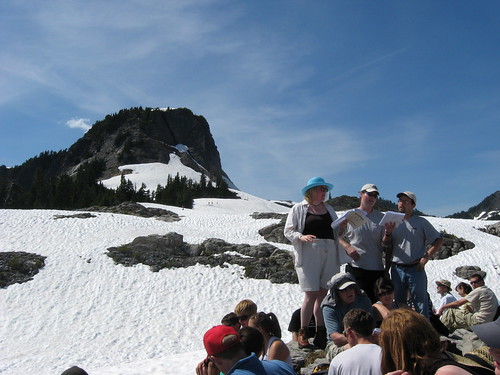
*Photo by Greg Wolfe - that's me in the blue hat, singing atop snowy Mt. Baker with Richard From Singapore (center) and Joe Amsberry (on the right)

Monday, January 05, 2009

This really struck me

Here's a quote by Caryll Houselander I ran across on Mark Shea's blog this morning:


I saw too the reverence that everyone must have for a sinner; instead of condoning his sin, which is in reality his utmost sorrow, one must comfort Christ who is suffering in him. And this reverence must be paid even to those sinners who souls seem to be dead, because it is Christ, who is the life of the soul, who is dead in them; they are His tombs, and Christ in the tomb is potentially the risen Christ. For the same reason, no one of us who has fallen into mortal sin himself must ever lose hope.

Beautiful.  Sobering.

Needs more meditation/rumination.

Sunday, January 04, 2009

The bomb under your chair

Found this on a blog I follow - it's not to everyone's taste from either a cultural or religious point of view, but I found the author's take on Radiohead's House of Cards insightful. Here's a link to the video.


When I first heard this song on the radio a few months ago, I turned it off immediately after I heard the opening line: "I don't wanna be your friend - I just wanna be your lover."  I thought, Well, then, screw you, sir.  Next!  Hierothee's commentary is more charitable than my gut reaction was, and I begin to see what he sees in the song.

The interview with Thom Yorke from 2005 is fascinating as well.  Worth a read by any and all Radiohead fans as well as those interested in the intersections of Christianity and art.  This is one of those things that art critic H.R. Rookmaker called "the bomb under your chair", placed there by artists who are desperate to communicate their search for meaning in a fallen world.

Things that we should sit up and notice, and consider.

Friday, January 02, 2009

Happy New Year

I've been tagged by Allen Lewis!


So, here's the rules of our game:

1. Link to the person who tagged you (see above).
2. Post the rules on your blog.  (Look at me, Ma - I'm postin'!)
3. Write six random thing about yourself. (Hm...)
4. Tag six people at the end of your post and link to them.
5. Let each person know they've been tagged and leave a comment on their blog.
6. Let the tagger know when your entry is up.

OK - my six random things:

1. I met my husband Gary when we were in college in the '80s.  We went on one date; I graduated and moved away, we completely lost touch for 10 years, and then we ran into each other in 1996 at a Christian music/arts festival attended by 25,000 people.  Ah, Providence.
2. I once saw and said hello to Mark Farner of Grand Funk Railroad in person at the tiny Christian record label I worked for in California in the '90s.  He was going out the door as I was coming in.  (You said random...)
3. I love to disentangle things - strings, chains, yarn, Christmas lights, etc.  It creates a state of deep meditation for me.  If I could get paid for disentangling string/untying knots, I'd be filthy rich.
4. I dyed my hair blonde for the first time in my life back in August.  I did it for a show I was in; I've gotten lots of compliments on it and Gary likes it, so I think I'll keep it this way.
5. My sister Susan is a science teacher for accelerated/gifted students.  She's my biggest fan and most faithful friend in the world.
6. My father-in-law is a rocket scientist.  (No, really - scroll down for a picture of Charles Lundquist giving a lecture on orbital mechanics to W. Von Braun et al. in 1958.)


Tag - you're it!  And here's hoping your New Year is a Happy one!

Friday, June 13, 2008

Sam Phillips at Borders in Tigard


Hey, I'm back.  :)


I've been busy lately writing some new songs, a few essays here and there, and I hope to start blogging more regularly soon.

I just had to share this, though - Gary and I saw Sam Phillips play live at Borders Books & Music in Tigard, OR as part of a tour she's doing for her new album, Don't Do Anything.  She hadn't been to Portland in 12 years, and I hadn't seen her live since 1992.

Sam's music has been a great source of spiritual companionship in the years since I first discovered her in 1985.  She shifted out of the evangelical Protestant paradigm at approximately the same time I did (late '80s-early '90s), and her poetry and songwriting have been a guiding light for me in terms of depth, honesty, and quality.  Often, her songs are aids to prayer for me, since she seems to give words to what I'm really feeling and help me show my real heart to God.

The show yesterday was just her and a fellow who played a Stroh (I think that's how you spell it) violin and an electric guitar that looked (and sounded) like it had been ordered out of a Sears catalog in about 1962.  Since the release of Fan Dance in 2001, she's adopted a really interesting acoustic/retro/vaudeville/early jazz sort of style of music for her songs, which are as deep, melancholy, and beautiful as ever.

Anyway, seeing her, listening to her, experiencing her was... ah.  What words to use?  Inspirational takes it the wrong direction.  Exciting doesn't capture it.  Profound gets closer.

I had a conversation a while back with a friend on a message board that I had up on my website for a while, but took it down recently.  I want to post it again here in her honor:

[Pal:] As far as the Sam Phillips thing, I had been listening to her music all the way back from her Leslie Phillips days.

[Me:] Sam, lovely Sam!  I have everything she ever recorded - even a couple of hard-to-get promotional things.  I first discovered her in her Leslie days, in about 1985, and I've followed her closely up to the present [about 2001].  How do you like "Fan Dance"?

[Pal:] After "Die Hard with a Vengeance", I remember sitting in Dennys talking to a more traditional Christian (for lack of a better term) friend about why on earth would she play the part she played in that film (psycho murdering sexpot).  I argued in her favor, and eventually won him over, although I can't for the life of me remember what I said to convince him.

[Me:] ! Good for you.  I thought Sam was fantastic in DHWAV - no one else could have done that look that she had.  Re: the security guard murder scene (hearkening back to our slasher/horror discussion), I remember hearing Sam in an interview around that time describing her feelings about the scene.  At first she had trouble getting into it, but then she met the actor that was playing the security guard.  To her, he resembled Rush Limbaugh... and after that, she had no trouble with the slashing and blood...    :^0

[Pal:] Similarly, T-Bone [Burnett]'s work with the Coen brothers hasn't exactly been mainstream Christian work either, but it's more wonderful than so much of CCM.

[Me:]  Amen to that.  Gary and I both love T-Bone.  So glad to see his work recognized at the Grammys this year.

When I lived in southern California in the early 1990s, I had the opportunity to see Sam and T-Bone do a little set together at McCabe's Guitar Shop in Santa Monica.  It was one of the strangest but most wonderful shows I've ever seen - Sam singing, T-Bone playing guitar ("stomping his foot like a manic grandfather", one reviewer said), their buddy Van Dyke Parks doing some earnest but not-quite-there instrumental string stuff, and some weird comedy bits interspersed.

[Side note: The weird comedy bits included several appearances by the "Zen Nude Dancers".  The store staff passed out paper bags with eyeholes cut in them before they came on.  I was with a bunch of guys from Frontline, the Christian record company I worked with from 1991-1992, and they all were giggling nervously.  One of them, Michael Black, turned to me and said, "If you tell anyone about this back at the office, you're dead, do you understand?"  I joined in the nervous giggling.  The act, as it turned out, consisted of one (clothed) pole dancer who gyrated onstage for about 30 seconds and then left.  It wasn't prurient, really, just... weird.  I guess that was the Zen part.]

My fondest memory of that night:  After the concert, Sam and T-Bone were out in the foyer, autographing stuff and shaking hands.  The guys from the record company all mobbed Sam, peppering her with questions and dropping names.  I stood about two layers of people back, staring at Sam, but also at the plate of cheese and crackers in her hand that she'd brought out from the green room, since no one had eaten them.  I was really hungry, since we'd driven to the show in Santa Monica straight from work [in Newport Beach - about a 2-hour drive in traffic] without stopping for dinner.  Sam saw me eyeing the food and handed the plate back to me, across those two layers of record company dudes.  May God's blessings always rest richly upon her soul.
I was hungry, and you fed me...

A small kindness, but my heart was touched by it - and it seems symbolic of the sort of presence you are for me.  God bless you, Sam.  Thanks for coming to see us.

[H/T for photo - www.samphillips.com]

Thursday, May 03, 2007

I wrote a new song this week

Just wanted to share a new song - it's the product of some inspiration from looking at a hymnal I found in the pew at St. Anthony's a while back, along with some thoughts from the Holy Thursday liturgy where we hear about Judas year after year. Here it is:

Said Judas

Said Judas to Mary, “About that perfume –
It’s an extravagant waste, and you shouldn’t assume
that you’ll impress Jesus by filling the room
With the thick, heavy scent of expensive perfume…
True holy women, they think of the poor –
They keep to the background and don’t act like whores.
The Master’s saving the world – he doesn’t have time for just one.”
She stood back embarrassed, but Judas wasn't done.

Said Judas to Peter, “I know what you want -
to be right-hand man in the Kingdom of God.
Your “humble fisherman” act is a transparent fraud –
To condemn and control people – that’s what you really want…
You don’t understand what real people go through,
and I won’t be led by a coward like you.
Neither would the rest, if they’d seen what I’ve seen.”
Then Peter went out, and he wept bitterly.

Said Judas to the chief priests, “What can I say?
Jesus spoke of a Kingdom, like we had back in the day,
But he’s misused his power and made some bad plays –
And it’s looking like time for a full expose’...
And I just want my share of the credit, you know –
I think I deserve a little quid pro quo.
I’ll sell you my story for the going market rate.”
They shook on the deal, then Judas went out to celebrate.

Said Judas to Jesus in the garden that night,
“Dear Master, I’ve come to help you see the light.
Don’t look at me like that – you know that I’m right!
Just go with us now, and it’ll all be over by tomorrow night...
I realize my actions might be misunderstood
But you know that I love you – it’s for your own good.
You would have been a great king, how could you let it come to this?"
Then Jesus said, “Judas, you’ve betrayed me with your kiss.”

Said Judas to the children of God in that place,
“Beware as you contemplate my fall from grace –
You never can tell just when I’ll show my face.
You’ll never be rid of me, ‘cause you stand in my place...
You’ll hear me speak through your brother, or maybe see me in the mirror.
Whether your heart’s free with love, or shackled by fear,
it’ll scream who you are without making a sound.
Remember you’re headed my way, to a hole in the ground.”

- © KJL April 2007

Monday, April 23, 2007

Couldn't resist this

I saw this on some friends' blogs this morning and had to find out...

My Peculiar Aristocratic Title is:
Venerable Lady Kathleen the Sonorous of Londinium-le-Thames
Get your Peculiar Aristocratic Title


Very nice. Any and all tributes to secure my good graces will be now be accepted.

Thursday, March 22, 2007

Assisted suicide debate rears its head again in California

Last month, California legislators once again introduced a bill to legalize physician-assisted suicide. This is a very bad idea, for reasons I previously described here.

The LA Times article speaks glowingly about the report published several weeks ago by Oregon's Department of Health and Human Services that ostensibly describes how the "Death with Dignity"/assisted suicide law is being used. (Click here to see the report, and here to read an Oregonian article covering its release.)

The DHS report is very short compared to the ones done initially in the '90s, when the law first went into effect - there's even less information and documentation than the (minimal) amount in the first ones. Nevertheless, here are some questions that come to mind:

First, the report states that "forty physicians wrote the 65 prescriptions." Hm. That means the docs who wrote them and the folks who took them don't map one-to-one; i.e., the prescriptions weren't written by each patient's regular doctor. This also means there were some physicians who wrote multiple lethal prescriptions. Are suicide-minded patients are starting to seek out doctors they've heard are sympathetic to the cause?

Further down: "Complications were reported in four patients during 2006; they all regurgitated some of the medication." What happened to them? Did they recover? Did they die of natural causes? Did they try suicide again? Did they "need help" to make sure they died? The report doesn't say.

And, "During 2006, 10 referrals were made to the Board of Medical Examiners (BME) for incorrectly completed reporting forms. The BME found no violations of “good faith compliance” with the Act..." What the ____ happened here? What sorts of errors were on these forms - incomplete/omitted information? Information that could shed some light on who did what in the patient's room on the day of death, perhaps? If medical records are legal documents (which they are), why was no one disciplined for poor medical recordkeeping? Are we playing a game of "don't ask, don't tell" here?

Whatever your opinion may be about physician-assisted suicide, you should realize the medical aspects of this stink to high heaven. And they attack the senses of the spirit, just like the stench of abortion.

For more information, visit the website of Physicians for Compassionate Care.

Thursday, February 22, 2007

Pray for Stephen Colbert today


Just a quick note to encourage you all to send up a shout to Jesus on behalf of Stephen Colbert, host of "The Colbert Report" on Comedy Central.

He's discovered that he's today's pick in the 2007 list of Praying for the Worlds 365 Most Influential People: 5 Minutes a Day to Change Your World, published by Harvest House. On his show this week, he's been calling up other people listed in the book to ask if anything's happened to them as a result of being prayed for. Check out this clip of him talking to Candice Bergen...


For those of you who aren't familiar with his schtick, "The Colbert Report" is a fake news show on which Colbert does a send-up of the blustery pundit and interview style of Bill O'Reilly. The unique things about Colbert are:

1) He's a cradle Catholic and admits in interviews to being a true believer in the Church, though he doesn't support the Magisterium on the usual pelvic issues - par for the course for an American cradle Catholic, I suppose.

2) He retains some respect for God and the Church in his act. He was the host of the "God Stuff" segment on "The Daily Show" for a time and kept well clear of the line between ridiculing those who practice the faith in strange ways and the actual content of the faith.

3) He's amazingly fearless in his satire of the political scene. When I watched his speech to the national press in front of President Bush about a year ago, and watched the broad, open smile on the president's face fade as Bush realized he was being poked fun at, I thought the next scene we would see was Colbert's head rolling down the front steps of the White House. It was unbelievable - and though I didn't agree with all his points, I thought it was brilliant.

4) He's blisteringly funny.

In the Candice Bergen segment, he seems terrified of what's going to happen to him today. But that's a good thing, I think - it shows how much he believes in his heart that something will happen.

So, pray for him and his family today. Let's see what happens!

Tuesday, November 28, 2006

Keep Satan in Christmas!


A shocking title for a blogpost, I know - one that's likely to send some of my recent visitors (see below) from 0 to Apoplectic in 1.6 seconds. But I just had to share this nice little piece in Touchstone Magazine with you on the blessings that the "liturgy" of Christmas carols can bring to us. Enjoy.

Friday, November 24, 2006

Christus homo factus est

A couple of meditations for you on the beginning of the season of Advent, coming up soon, on the following topic: What does it mean that Christ became a man?

First is a reflection by Fr. Raniero Cantalamessa in this month's Magnificat:

The expression "except in sin" (absque peccato) used of Jesus (cf. Heb. 4:15) does not convey some exception to the full and definitive human nature of Christ, as though he were in all respects truly human like ourselves, less one thing: sin - as though sin were an essential and natural characteristic of human nature. Far from derogating from the full humanity of Christ, "except in sin" constitutes the distinguishing feature of his true humanity, since sin is the only true "superstructure," the only spurious addition to the divine project of human nature. It is surprising how we have reached the point of regarding as most "human" the very thing that is least human. "To this point has human perversity arrived," says Saint Augustine, " that he whom lust overcomes is regarded as a man, whereas he who has overcome lust cannot be a man. Those who overcome evil cannot be men, whereas those whom evil overcomes are men indeed!" "Human" has come to mean rather what we have in common with the beasts than what distinguishes us from them, such as intelligence, will power, conscience, holiness.

So Jesus is "true man" not in spite of being without sin but precisely because he is without sin. In the famous dogmatic letter of Saint Leo the Great we read: "He, true God, was born in an integral and perfect nature as true man, complete with all prerogatives, as well divine as human. In saying 'human' however, we refer to those things which the Creator originally placed in us and which he then came to restore; whereas in the Savior there was no trace of those things that the Deceiver added and that man deceived accepted. It is not to be thought that he, because he willed to share our weakness, also participated in our guilt. He assumed the condition of a slave, but without the contamination of sin; he thus enriched mankind but did not diminish God."


Caryll Houselander, a Catholic writer in the 1940s, also had this to say in her lovely book of meditations on the Virgin Mary, whom she called the Reed of God:

This is what it meant to Mary to give human nature to God.

All other children born must inevitably die; death belongs to fallen nature; the mother’s gift to the child is life.
But Christ is life; death did not belong to Him.
In fact, unless Mary would give Him death, He could not die.
Unless she would give him the capacity for suffering, He could not suffer.
He could only feel cold and hunger and thirst if she gave Him her vulnerability to cold and hunger and thirst.
He could not know the indifference of friends or treachery or the bitterness of being betrayed unless she gave Him a human mind and a human heart.

He was invulnerable; He asked her for a body to be wounded.
He was joy itself; He asked her to give Him tears.
He was God; He asked her to make Him man.
He asked for hands and feet to be nailed.
He asked for flesh to be scourged.
He asked for blood to be shed.
He asked for a heart to be broken.

The stable at Bethlehem was the first Calvary.
The wooden manger was the first Cross.
The swaddling bands were the first burial bands.
The Passion had begun.
Christ was man.


(For an audio version of the Houselander piece, stop in to my website and listen to Advent Meditation.

Blessings on you as you follow Mary's example and "ponder these things in your heart" this Advent season.

Tuesday, October 31, 2006

A Review of The Magic Eightball Test


Here for your reading pleasure is my review of my friend Lint Hatcher's latest offering. Lint is the founder and former editor of WONDER Magazine, as those of you who've read the posts below are aware, and a fine writer. Visit him at Hambangers Junction Gazette or Excuse Me, Ghidorah, or go on over to lulu.com to see the book (with Lint's own graphic design work on the cover).

Enjoy! And a Happy Halloween to one and all!

=============

On the cover of the first edition of Lint Hatcher’s The Magic Eightball Test: A Christian Defense of Halloween and All Things Spooky, the reader is greeted by the author’s own sketch of a strange gathering of fictional characters, including a traditional-looking, long-nosed, pointy-hatted witch with a pumpkin cauldron – but on a second look, she’s holding the cauldron by a handle over the open top. It has chevron eyes and a zigzag mouth on the front, and my brain can’t resist the urge to morph the cauldron into one of those plastic jack o’lanterns that children use for trick-or-treating. Then there’s an Orc-looking/imp-like fellow next to her, and a fairy princess modeled on Disney’s Cinderella, and a small being (a child? E.T.?) underneath a sheet with eyeholes cut in it. The group is fronted by Batman’s young sidekick Robin sporting an inordinately serious expression, gravely holding a large black orb – our titular Magic Eightball. Towering over the other characters from behind is the more familiar figure of Frankenstein, with an incongruously cheery, grandfatherly grin spread across his wide face. [Note: This illustration is on the cover of the first edition; the current cover above is different, but also cool.] I get the feeling that though the subtitle introduces the book as “a Christian defense of Halloween”, this won’t be heavy theology – Hatcher doesn’t seem averse to applying a sense of humor to his subject.

The chapter titles include evocations of classic Halloween kitsch (“Chilling, Thrilling Sounds of the Haunted House”) and wry twists on pagan propaganda (“The Ancient Art of Pop-O-Matic”). Hope rises in my heart that I won’t be drenched with a firehose stream of Biblical prooftexts and platitudes that sound like they were uttered by a talking head with horn-rimmed glasses and a blonde bouffant hairdo. I plunge in.

Hatcher begins his ambitious project by describing the attraction that the season of fall has for him:

It’s a kind of music. For me, it’s built into reality and it’s saying something good to me. Just as “the heavens proclaim the glory of God” in a manner that is aesthetic, almost musical, rather than prosaic, the coming of autumn says something romantic and pure to me. It sings about Nighttime, and Winter, and the liveliness of Death, about truths too difficult and painful to accept any other way – except, perhaps, through the words of some great poet.

And because autumn is a kind of music, Halloween is a kind of dance.


He then discusses the various aspects of Halloween as we experience it in America: 1) the autumn festival, 2) a night of “make-believe”, and 3) a celebration of all things spooky. He gives a brief history of the holiday’s origins, being careful to distinguish between the Celts’ worship of nature and the celebration (or veneration, if you will) of the creation that we engage in at harvest time. He tells a funny but tragic story of dressing up like Cornelius from Planet of the Apes one day and going to school – a day that unfortunately was not Halloween, but rather a balmy day in March. He writes: “I remember suffering a lot throughout the day, horribly burdened by a growing realization. ‘What kind of world is this’, I thought, ‘if you can’t go to school dressed up like a gorilla?’ The question haunts me to this very day.” As well it should all of us.

For Hatcher has uncovered a very important aspect of our humanity that has been forced to lumber off and hibernate in the face of rationalism’s and cynicism’s encroachment into its territory: our sense of awe and delight in God’s creation, in who we are as God’s creatures, in all of life’s glorious possibilities that an active imagination makes available to us.

Hatcher is careful to draw a bright line between the type of occultism that is actually practiced by serious believers in dark powers and the “pop” occult trappings of our modern Halloween celebration. The means of distinguishing the two (again referring to the book’s title) is The Magic Eightball Test. He contrasts the familiar Magic Eightball toy with the Ouija board and asks:

When people place their trembling fingertips on the triangular planchette of a Ouija board and ask a question, to whom are they speaking? “The spirits.” Whether a person believes or not… they formally address their questions to the spirit world. Thus, some creature may answer – and in fact it may make very little difference to that creature whether he is believed in or not.

Okay. When a person asks a question of the Magic Eightball, who are they talking to? Who do they know darn well that they are addressing?

That round piece of plastic there. The one with the number eight painted on it. The one full of blue liquid and, hey, why don’t we break it open to see how it works, huh?

…[W]e ply it for answers… like a Pop-O-Matic dice roller. If we don’t get the answer we want, we shake it up again.


This is the heart of Hatcher’s argument and defense of Halloween and its spooky accoutrements – things like Dracula costumes, trick-or-treating, and decorating one’s house with black cats and gravestones are simply responses to the idea of the spirit world - cultural echoes of real encounters, perhaps, but no longer conveying the reality of the things they signify. They are “make-believe”, an experience of “playing pretend”, like a father playing with his children by growling like a lion and chasing them around the living room. They allow an acknowledgement of evil and the “spooky aesthetic” that hangs about certain creatures, but not a participation in an actual experience of it.

In Hatcher’s description of his friends’, family’s, and schoolmates’ reactions to his creative flights of fancy and his interest in things that others find distasteful, I can’t help but notice a quiet exasperation, a tiny bit of resentment, a touch of sadness in his tone. I find myself asking: Where does our childlike sense of wonder go when we cease to be children in the physical sense? How can we tap into, or perhaps recover, our ability to sense the thrill of an encounter with the supernatural – what Hatcher calls “the spooky gene”?

This is where Hatcher draws on the expertise of English journalist and poet G.K. Chesterton to provide “Deep Background” for his worldview. He reprints Chesterton’s essays On Holidays, The Spice of Life, and The Nightmare, all of which further explore ideas of culture and experience, and lend solid support to his position. Chesterton apparently was also possessed of the “spooky gene”, as he describes in the closing paragraph of The Nightmare:

Therefore I see no wrong in riding with the Nightmare tonight; she whinnies to me from the rocking tree-tops and the roaring wind; I will catch her and ride her through the awful air… I will ride on the Nightmare; but she shall not ride on me.

Also reprinted in this volume is Hatcher’s essay Wunderkind, a fictional diary of a young man traveling the pathway of popular culture and rediscovering his childlike sense of wonder through a renewed sacramental understanding of the world. An engaging personal autobiographical note closes the slim volume.

On a personal note of my own, I had the privilege of attending a Halloween party once with Lint Hatcher, his family, and about 50 other revelers in a tent at a Christian music and arts festival. You may think this an unlikely place for a Halloween party, but trust me, the time was just as unlikely as the venue – Fourth of July weekend. The theme of the lecture series taking place at the festival was “Days of the Dead”, including Halloween, All Saints’ Day, and the Mexican celebration of Dia de los Muertos, with lectures and discussions of their cultural and religious contexts. Hatcher was a speaker at the event and delivered “The Magic Eightball Test” as a short speech before the party started. He was well received by the assorted zombies, ghosts, mummies, Goths, and vampires who had gathered for the festivities.

I had carefully planned my costume – in honor of St. Francis of Assisi and his Canticle of the Sun (mentioning Brother Sun, Sister Moon, etc.), I had come to the party as Sister Death – all gothed out in black from head to toe, in whiteface with big black eyes, and blood red lipstick with a trail of stage blood dripping from a corner of my mouth. Just as the dance was getting going, I was in a corner of the tent putting the finishing touches on my makeup when Hatcher and his son Nick came over. I heard him say, “Oh, man!” and looked up, and he met my wide grin with one even wider than mine – extended (by a creative makeup job of his own) at one side to reveal several bare teeth, a bony jaw, and a grotesque vermilion border – reminiscent of the expression of the title character in William Castle’s classic film Mr. Sardonicus. Together we rejoined the crowd and cheered for the band as they kicked into some high-energy surf-rock with horror-show parody lyrics.

Lint Hatcher “gets” Halloween – whatever it once was, whatever it may be to some, it’s definitely wonderful fun.

Thursday, September 14, 2006

Thoughts on Predestination


A friend of mine and I were talking the other day, and he mentioned he had stumbled over the concept of predestination recently. It made me stop to consider my own run-ins with this idea and the extent to which I've worked on it as regards my own spiritual life. Though I don't have it completely philosophically integrated, here's what I've got so far.

I grew up in a Christian home; I was raised in an American Baptist church, kind of on the liberal end of a conservative tradition. For example, my mom had a bottle of wine in the refrigerator, we went to all sorts of movies, no one ever said anything about playing cards – but there was definitely no swearing and no smoking.

Anyway, the first time I prayed the “sinner’s prayer” and asked Jesus into my heart, I was 5 years old. I had an experience of praying to “recommit” my life to Jesus when I was 8; I think it was because I felt really guilty about something (which I can’t remember now) and I thought I was a “backslider”.

The time that I point to as my actual age-of-reason conversion was when I was 12. I had been involved in a “Bible Club” children’s ministry through the family of my best friend in elementary school, where I learned to pray and read the Bible for myself. One afternoon I was sitting on my bed reading I John, and I came across the part in Chapter 4 where it reads: “If anyone says he loves God but hates his brother, he is a liar; for whoever does not love his brother whom he has seen cannot love God whom he has not seen.” (v. 20-21). That hit me between the eyes, because I really did hate my brother – and it showed me for the first time that I wasn’t loving God. I’d tried to be a good girl and not get in trouble and everything, and I thought that was enough to be a Christian. At the same time, there were terrible amounts of resentment and hatred building in my heart against my older brother because of how violent he was with my sister and me. (FYI, my older brother Steve was diagnosed with schizophrenia when he was 16 and has been managed on medication since then.) Anyway, having been confronted with this spiritual truth by the Holy Spirit Himself through the Scriptures, I realized I needed not just to believe, but to change and be changed – and so, that was my first conscious, engaged beginning as a Christian. I was baptized (like a good Baptist) several months later.

Here’s my first encounter with the concept of predestination: When I was 16, I changed schools and started at Catlin Gabel as a sophomore. I’d only had a few close Christian friends in my life up to that time, but now they were all pretty much gone, and none of my new friends shared my faith at all – in fact, one girl attacked me about it fairly regularly. I looked around at other classmates of mine who were smoking (tobacco and other substances), drinking, and sleeping around – and they appeared to be having fun. The thought occurred to me: Why am I sitting around being “moral”, when I could be having fun? As I started to think more about it, I began to resent the fact that I’d been raised as a Christian – I really didn’t know any other sort of life. In my church and at Bible Club, I’d heard about how you had to make a choice to follow Jesus, but I began to see that I was never really given a choice – about big things like this, things that seemed to matter and shape your life. My mom and dad (who both had demanding careers) were a little disengaged at times in my upbringing, but they were very definite about going to church and the importance of being a certain kind of person. I suppose I bought into that in order to be close to them in the midst of the chaos that Steve’s illness brought into the family dynamics. But I began to think seriously about whether I still wanted to be a Christian – and what I would be if I weren’t a Christian.

I had internalized the Baptist adage “once saved, always saved”, but instead of comforting me, it began to make me angry and a little confused. Of course, as a good Christian, I wasn’t supposed to want things that were bad for me, right? If God was so pleased with me being with Him, why wasn’t I happy and joyful all the time? Did that mean that I really wasn’t one of the “chosen”, that I wouldn’t be happy in heaven? What if there was real happiness in a place other than heaven? And if I was predestined for heaven, “eternally secure” as my Sunday school teacher put it, that means I’ve got my “fire insurance policy” and it doesn’t matter what I do between now and when I die because it’s not about works, it’s about faith, right? Does God really know what I’m going to choose before I choose it? If He does, then what does it matter?

After much serious thought and prayer, the way it came down in my 16-year-old mind was this: God is outside of time. We’re not; we have to live through time. So, God knows what we’re going to do, decide, and choose – but we don’t. (Somehow that thought had more force in my head back then than when I look at it here on the page right now.) The fact that humans can’t know the future means that if God is all-knowing, He is in fact sovereign over us.

And, I realized that I only had this one personal identity, this identity as a Christian, built on knowing Jesus. I realized that if I decided not to be a Christian anymore, I’d have to completely rebuild my self-concept from scratch – I’d have to completely scrap my whole life experience up to that point. Because I had read God’s promises in the Bible – things like “If you keep your mind stayed on Me, you will have perfect peace” (Isaiah 26:3) and “If you obey Me, I will bless you” (Job 36:11). I had seen that work in my life. I realized that if I stepped outside of that, there would be no guarantees. If I were to smoke pot or drink or go ‘round with boys, I might be happy – or I might not. With my Christian life, life with God, He was offering me a guarantee – a promise. It dawned on me that if I believed He loved me, then I had to trust Him – even if it meant giving up these other pathways to happiness, that for all I knew really would make me happy (though in hindsight, I can see that such happiness would have only been temporary).

I suppose you could draw a couple of conclusions from this: either that I was just stuck with being a Christian because I didn’t really have the courage to try anything else, or that I couldn’t leave Jesus because I knew deep down that, despite everything, He really loved me. I suppose that both are true in a sense.

=============================================================

I recognize that in principle, there’s still an existential tension between God’s omniscience and the threat it poses to the meaning of human choices. The following analogy resonates the best with me presently on this score:

God is the Author of the book in which we are all characters. From His perspective, it’s as if we were two-dimensional, living only on the page in the mind of God and any readers. As the pages turn, we live our lives and make our choices, and we reap the benefits or suffer the consequences of those choices. We can’t skip ahead in the book and see what’s to come, what certain choices will bring; we can’t turn back and undo things that didn’t turn out as we would have liked. God is the one who in that mysterious Other Dimension creates us in His mind and writes us and our lives on the page, fleshing us out and making us real, fully human, present to ourselves and to others. He can skip ahead or go back, or enter or observe our timeline at whatever point He chooses. He remains in ultimate control as the Creator and Author of human history, but because our character and nature as humans is reflective of His, He allows us the small reflection of His limitless power over the universe which we call free will. As far as we who live “in the book” (i.e. in the space/time continuum) are concerned, though this power over the course of our lives isn’t absolute like God’s, it is quite real, because God made it as part of our human nature.

It’s tempting to cop an attitude about God’s sovereignty and resent the fact that He didn’t give us ultimate power over our own lives, and then do a passive/aggressive thing of refusing to use the power of will that He did give us to order, control, and shape ourselves and our world – we shirk our responsibilities to act/contribute to the world and end up slacking (spiritually speaking), like a petulant, morose, full-of-himself adolescent. I think we make a mistake when we don’t regard free will with the dignity that God gives it. After all, God really allows us to do stuff – to build things, to invent things, to be mini-creators. Our free will, our freedom, is a good thing, given to us so that we can reach our potential as human beings for God’s glory; St. Augustine said, “The glory of God is man fully alive.” Freedom is not to be pissed away and squandered on things that don’t build up, nor to be pissed on and left to atrophy. It’s part of the image of God in us and should be respected as such. After all, God respects it; He lets us make our choices and succeed, or screw up, or both, without sending angels or thunderbolts or apparitions at every turn to coerce us in what we choose. When those freaky things happen, I don’t believe it’s ever to force our hand, but to encourage us toward the right thing regarding something really important – something that’s really going to matter for someone else.

==============================================================

On a secular level, when God is removed from the picture (or equated with matter/the natural world), this question degenerates into the familiar debates of nature vs. nurture, genetics vs. environment, materialism vs. existentialism. From this perspective, it’s my view that our development as humans is comprised of both our genetic inheritance and what we choose to do with it. We can’t mutate our own genes at will, but neither can we escape living on planet Earth – they both affect us and shape us in different ways. It’s a cooperative, interactive thing, sort of like the way that God calls us to cooperate with His gift of grace, both to accept His love and His choice of us (John 15:16) and to work out our salvation with fear and trembling (Phil. 2:12).

==============================================================

Re: spiritual “dimensionality”, try this on – it’s a poem I wrote several years ago.

[On looking at plates from the Book of Kells:]

His hair is drawn at the ends
into an undisentangleable knot,
the strands reaching into the grapevines above His head,
into the borders where we, the Body,
discover ourselves
likewise inextricably woven.

You reach into, down, under
my heart and pull through -
I thread over, between, out
to curl beside you,
happy for companionship on this plane
but yet still aware
of the Light, the Eye,
the unbound dimension
whence come mysteries of
color and shape and proportion.

We know what we mean -
whether we are beautiful,
we cannot tell.

© 1995 KJL

=============================================================

A corollary question to the predestination vs. free will dichotomy is this: Is it possible for a Christian believer to lose their salvation, i.e. to be a Christian one day and not be one the next? Since it’s assumed there’s a line between “saved” and “not saved”, and one crosses this line in order to enter the Kingdom of God, is it possible to step back across it into darkness, total lostness, again?

I was part of a good-sized independent charismatic church in my late twenties, and many of my friends came from Assembly of God or Pentecostal backgrounds (heavily influenced by Armenianism). Over the years that I was there, I began to see people who I thought were strong believers just get up and walk away from the faith. When my friends saw this happen, they acknowledged that the person had been saved by Christ but figured they had lost that saving grace in their lives through their disobedience and sin, and they would have to “get saved” all over again if they were going to get to heaven – i.e. go up to an altar call, pray to receive Jesus in their heart again, and start over from square one. They based this on Bible passages like Ezekiel 33:12-13, Matthew 13:19-21 and Hebrews 6:4-6 (the Hebrews passage is especially harsh if interpreted this way, since it would seem to mean that a person who falls away can’t ever get right with God again). They would talk about a “hardness of heart” to which God would just abandon people if they were stubborn enough. I, on the other hand, tended to think according to my “once saved, always saved” upbringing and if I watched a Christian walk away from God, just totally repudiate Him, it was hard for me to believe that he or she was ever really a Christian in the first place. I looked to Bible verses such as John 10:27-29, Romans 8:29-30, Romans 11:29, Ephesians 1:4, and I Timothy 2:4 to support my view. The idea that God could literally abandon someone in sin, just give up on a person, really bothered me, so I leaned heavily the other direction – though I realized that sin really does separate us from God. Jesus can’t have a relationship with someone who doesn’t believe in Him, hates Him, and/or never talks to Him, right?

When I began to study Catholic sacramental theology, I discovered a different model for understanding the phenomenon of how a person is saved, i.e. enters and stays in the Family of God. In this light, I found a different picture emerging from the Scriptures. In interpreting the Apostle’s teaching regarding the interplay between God’s foreknowledge and man’s free will, the early Church fathers and theologians don’t pit one idea against the other; they acknowledge that both concepts are valid and important. They base their interpretations on a couple of key concepts:

Great emphasis is placed on baptism as the beginning of one’s life in God. Catholics interpret the verse “Baptism now saves you…” (I Peter 3:21) in the most literal way possible. This is the way into the boat that takes you to the other side; this is the gate you pass through to come into the city. This is why Catholics, Presbyterians, and Lutherans baptize babies – it takes the place that circumcision had in the Jewish faith. It’s the initiation into the community, the tribe, the people of God. (And I’ll point out a cool fact which this interpretation suggests: Christ transformed this older Jewish initiation rite into something that women as well as men can receive.)

I learned a lot about my baptism when I became a Catholic – they regarded it with much more seriousness than I had up to that point. FYI, Catholics don’t ever re-baptize people; they figure that if a person has already received a Christian baptism (in water and in the name of the Father, Son, and Holy Spirit), they’re good to go as far as that’s concerned – God has already opened a channel of grace into their lives through that sacrament because the sacraments work of their own accord – they actually convey what they signify, in this case the removal of the stain of original sin and the rebirth of the soul in God (John 3:5-7).

Don’t think that I’m saying that baptism gives you a free ride into heaven, no questions asked; by no means. The Apostles also placed great emphasis on obeying Christ’s teachings and living a holy life. St. James insists that “faith without works is dead” (James 2:13-17); Paul talks about building one’s life in Christ out of various materials (I Corinthians 3:10-15) and “working out your salvation” (Phil. 2:12). Though original sin has been removed, a thing called concupiscence (that’s Augustine’s word) remains in our souls and bodies, in our being as humans. It’s the warp/distortion of our spiritual senses caused by hell’s fire, the smoke in our lungs, the holes/disconnects in our mind, the fogginess of our vision, the pull of gravity on our guts – what St. Paul complained about in Romans 7. This needs dealing with - all the time, because sin is serious, and hell is real, and we can still screw up real bad if we’re not paying attention.

However, that’s what getting saved is all about – it’s the process of repairing the damage, becoming holy, putting on the new man, being transformed more and more into the image of Christ. Catholic teaching points to the fact that in the Bible, various Greek verb tenses are used to describe salvation (“you have been saved” [Eph. 2:8], “us who are being saved” [I Cor. 1:18], “we shall be saved” [Acts 15:11]) – that’s past, present, and future. What Reformation theology regarded as a two-step process (first justification, then sanctification), Catholics regard as one single pathway called salvation. St. Paul also talks about the Christian life as being like an athlete in training (I Corinthians 9:24-27), a process of getting into shape so you can compete and win. This is what the other sacraments (confirmation, Eucharist, confession, etc.) and any other practices that help a person live holy and be like Jesus are for.

So, it’s a combination of both concepts, a synthesis: Our journey has a beginning in baptism, which God wills and brings about (with or without our cooperation), and then He expects us to follow through and grow in Him, to persevere toward the goal, and to establish His Kingdom and His Presence wherever we are – because the promise of redemption doesn’t belong to just us, to just our souls. Christ came to redeem all of Creation, the whole planet, including us - body and soul (Romans 8:19-23). So, our work as Christians is to join with Christ in “redeeming the temporal order” (Pope John Paul II’s phrase, I think).

So, if salvation is a process and not a line in the sand that you cross, then you can see why Catholics are reluctant to judge whether someone is “saved” or not. We look at people and consider where they are in relation to the Truth, what kind of grasp they already have on spiritual reality, and then try to encourage them toward a fuller understanding of the truth of Christ. This idea is foundational to all our interreligious dialogue – the idea that there is some salvageable good in nearly all religions and cultures, and people need to be encouraged to embrace that good more fully so they can progress toward more comprehensive transformation and redemption in Christ.

That's what I'm about on this blog, really. Just trying to whisper to other souls in the darkness: "Goooooo toward the liiiiiiiight. Gooooo toward the liiiiiiiight..."

[Hat tip to www.catholic-forum.com for the above image of St. Augustine.]